
Why Some Families Choose a Tirtha for Shradh
Families may choose a tirtha for inherited custom, sacred geography or focused remembrance. The decision should respect family guidance and practical needs.
In this article
Some families choose to observe Shradh at a tirtha: a place connected with pilgrimage, sacred geography and a living community of practice. The choice may continue a family custom, honour an elder's intention or create dedicated time for remembrance away from everyday routines. Other families observe at home or in another familiar setting.
These choices should not be turned into a ranking. A publisher cannot measure the spiritual result of one place against another, and this guide makes no such claim. Its purpose is to help a family understand why travel may matter to it and what to clarify before deciding.
What “tirtha” means in this guide
In ordinary pilgrimage use, a tirtha is a place through which people approach a religious tradition: often a river confluence, riverfront, temple town or another recognised sacred setting. The word carries deeper meanings in different texts and traditions, but this article does not assign one universal definition or ritual rule.
Place can shape an observance through geography, local memory, the presence of knowledgeable practitioners and the experience of travelling with a clear purpose. Those features explain the setting. They do not prove a predictable outcome.
For broader context on remembrance rather than a place hierarchy, begin with the ancestors topic hub and the site's learning guides.
Why a family may choose to travel
An inherited family practice
A parent, grandparent or customary priest may have named a place important to the family. Returning there can preserve continuity between generations. Before arranging travel, record who gave the guidance, which occasion it concerned and whether the instruction was specific or simply a family preference.
A setting that helps the family focus
Travel can separate a day of remembrance from work and household interruptions. A riverfront or temple town may also give participants a shared setting in which to speak about the person being remembered. This is a human and practical reason for choosing a tirtha; it need not be described as a guaranteed spiritual benefit.
Access to place-specific knowledge
Local priests and communities may understand the geography, current access conditions and customs associated with a particular place. A family should still explain its own tradition, ask what is proposed and agree on scope before beginning. Local knowledge should support informed participation, not replace consent.
A journey the family undertakes together
Planning and travelling together can itself become part of remembrance. That meaning depends on the people involved. An older relative, a person with limited mobility or someone who does not wish to travel should not be pressured in the name of a general rule.
Three different place contexts
Prayagraj and the Triveni Sangam
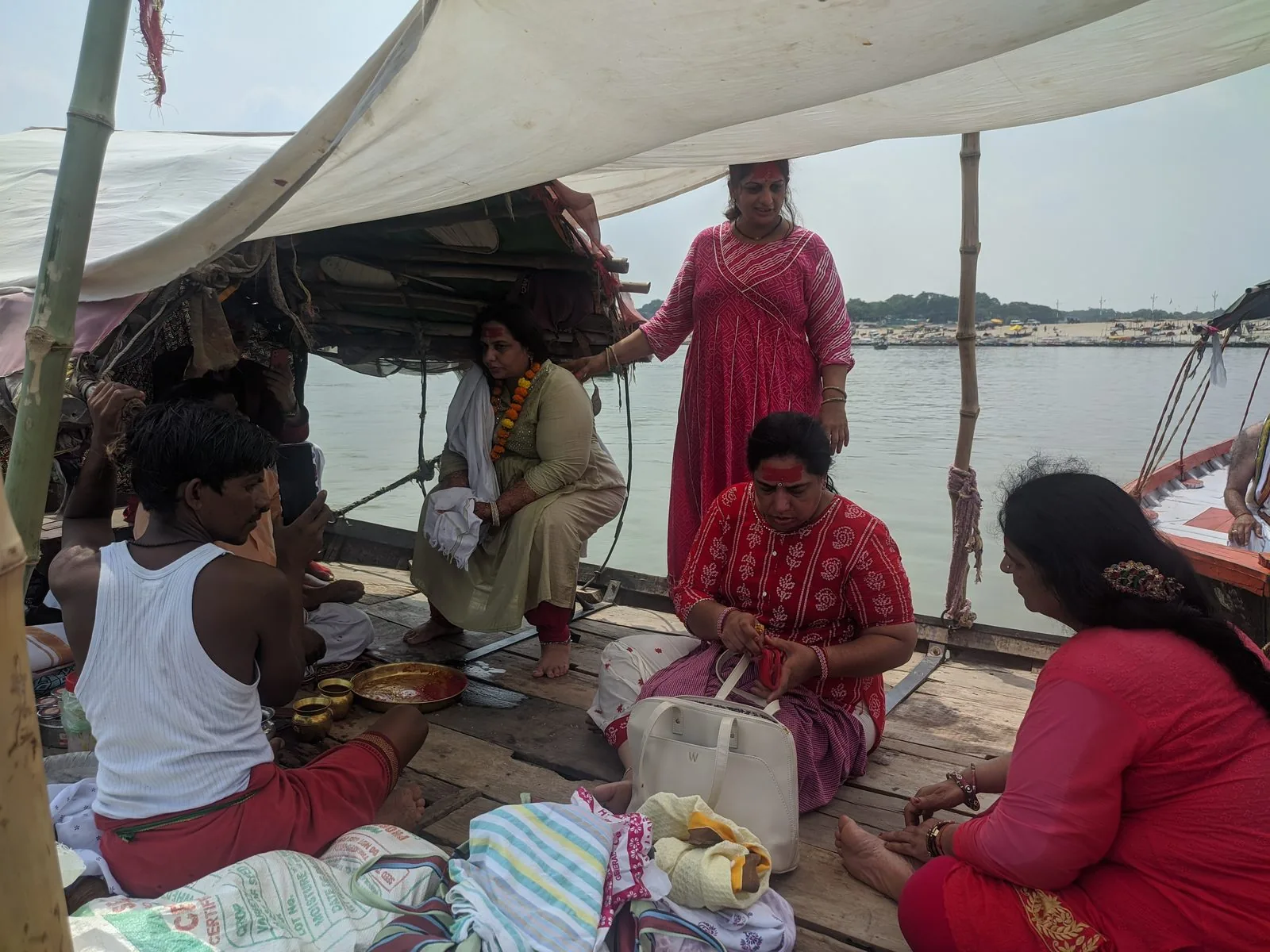
The District Prayagraj page describes the Sangam as the confluence of the Ganga and Yamuna with the traditionally understood, unseen Saraswati. It also notes priests assisting pilgrims and boats operating from the ghat. Families considering the Sangam should confirm river conditions, the meeting point, boat access and a suitable arrangement before the day. See the focused guide to Shradh and tarpan at the Triveni Sangam and the Prayag city guide.
Kashi and its riverfront ghats
The District Varanasi page lists many ghats and distinguishes their public uses. That matters because the riverfront is not one interchangeable ritual location. Families should ask which setting is being proposed, why it is appropriate, how it is reached and what privacy is expected. The Kashi remembrance guide and Kashi city guide provide further context.
Gaya, the Falgu and Vishnupad
The Department of Tourism, Government of Bihar connects Gaya's Pitrapaksha observances with Shradh, tarpan and pind daan at the Falgu River and Vishnupad Temple. Its Vishnupad destination page identifies the temple as a major place associated with pind daan. These official descriptions establish the destination's living tradition, not a result that can be promised. Read Why Families Travel to Gaya for Pind Daan and the Gaya city guide before planning.
A tirtha is not automatically the right choice
Travel may be unsuitable because of health, care responsibilities, cost, crowd conditions, weather or the needs of a grieving family. A home observance should not be described as inferior merely to encourage a journey. Nor should a remote transaction be presented as automatically equivalent to being present.
Ask the family's trusted elder or customary guide what applies in its circumstances. If opinions differ, document the questions rather than using fear to force a decision.
Questions to settle before deciding
- What family instruction or remembered intention supports this destination?
- Which tithi or occasion is being observed, and who should participate?
- What will be explained in a language the family understands?
- Which location is proposed, and what walking, steps, boats or transport are involved?
- What current rules apply to entry, belongings, photography and river access?
- What duration, materials and costs have been agreed in advance?
- Which elements are family custom, which are local custom and which are optional?
- How will names, lineage information, images and other personal details be handled?
- What alternative is available if health, weather or crowd controls change the plan?
The Pitrupaksha pilgrimage planning guide can help the family organise accessibility, travel documents, medicines, local contacts and contingency plans.
Choosing without inflated claims
A tirtha can be meaningful because it joins family memory with a recognised place and living tradition. That is enough to explain why some families travel. There is no need to attach numerical multipliers, guaranteed blessings, fixed place rankings or warnings of harm to the decision.
The careful approach is straightforward: begin with family guidance, learn what the place actually offers, check current conditions, obtain clear explanations and respect every participant's capacity and consent. The resulting choice may be to travel now, postpone the journey or observe closer to home. Each decision deserves an honest explanation rather than a universal prescription.
Considering this rite for your own family?
Tell us the rite, place, preferred date and family details you already know. A coordinator will reply by phone or WhatsApp; nothing is booked or paid for on this website.
Ask about this rite