
Tarpan Vidhi at Home: The Complete Step-by-Step Method
This guide explains the simple yet profound ritual of performing Tarpan at home, the sacred act of offering water to satisfy the gods (Devas), sages (Rishis), and ancestors (Pitrs). The preparation is minimal, requiring only a copper pot, water, black sesame seeds, and Kusha grass. The step-by-step sequence…
In this article
- Understanding Tarpana: The Soul of the Offering
- The Sacred Prelude: Preparing for Tarpana
- A Pandit’s Practical Guidance
- The Tarpan vidhi in order
- Where families differ, and why that is fine
- Why these three materials, and what the texts say
- Naming your ancestors: the sankalpa
- Two verses for ancestors no one else remembers
- Conclusion: Step-by-Step Guide to Performing Tarpan at home
Om Namo Bhagavate Vasudevaya.
In our world of complex schedules and demanding duties, many feel that our ancient rites are beyond their reach. But the truth, is that the most powerful rituals are often the simplest ones. Tarpana is one such jewel. It is an act of pure love, an offering of water, the very essence of life, to quench the spiritual thirst of the gods, the great sages, and our beloved ancestors.
Understanding Tarpana: The Soul of the Offering
Before we learn the “how,” let us understand the “why.” What is Tarpana? The word itself comes from the root trup, which means “to satisfy.” Tarpana is the act of satisfying. Whom do we satisfy?
- The Devas (Gods): The celestial beings who maintain cosmic order. By offering them water, we express our gratitude for the blessings of nature—the sun, the rain, the air we breathe.
- The Rishis (Sages): The great, illumined seers who gifted us the Vedas and the ocean of spiritual wisdom. We offer them water to thank them for the knowledge that guides our lives.
- The Pitrs (Ancestors): Our departed family members, who gave us this very body and life. This is often the most personal and emotionally resonant part of Tarpana. By offering them water, we nourish their souls, express our unending love, and help them find peace and liberation (moksha) on their onward journey.
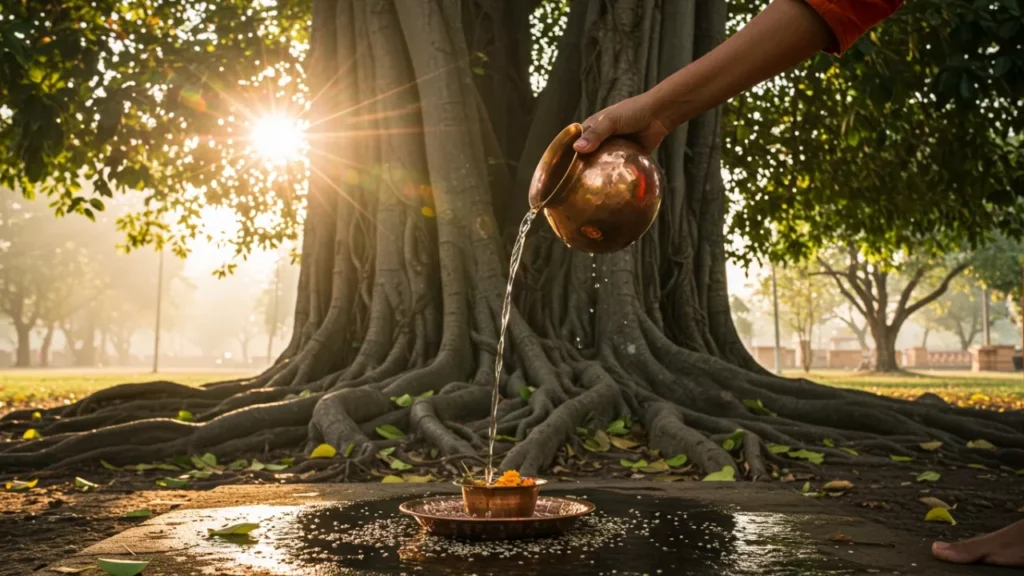
Imagine your family as a great tree. You are a leaf, enjoying the sunlight. But your existence depends entirely on the roots, hidden deep in the earth. Performing Tarpan at home is like lovingly pouring water at the base of that tree, ensuring that the roots are nourished, so the entire tree can flourish.

The Sacred Prelude: Preparing for Tarpana
A pure offering comes from a pure space and a pure heart. Preparation is a simple but vital part of the ritual.
1. Prepare Yourself (Atma Shuddhi)
- The Sacred Bath: Begin by taking a bath. Feel the water cleansing not just your body, but also the worries and stresses of the day.
- Clean Clothes: Wear fresh, clean clothes. Simplicity is key.
- A Calm Mind: Find a quiet moment. Sit and take a few deep breaths. Your calm, focused, and loving mind is the most important ingredient you bring to this rite.
2. Prepare Your Materials (Samagri)
You do not need an elaborate collection. The essentials are simple and beautiful:
| Material | Significance |
| A Copper Pot | Copper is a sacred metal that purifies the water it holds. If you don’t have one, any clean pot will do. |
| Clean Water | The primary offering, the symbol of life, purity, and flow. |
| Black Sesame Seeds (Til) | Absolutely essential for Pitru Tarpan. These seeds are believed to have the power to absorb negativity and carry the essence of your offering to the ancestors. |
| Kusha Grass (Darbha) | This sacred grass acts as a purifier and a conduit for spiritual energy. You can hold a blade or two in your hand or make a ring (pavitri) for your finger. |
| A Larger Vessel or Tray | You will make the offerings into this vessel, which you can empty later. This keeps your prayer space clean. |
3. Prepare Your Space (Sthana Shuddhi)
- Choose a Spot: Find a clean, quiet spot in your home. A balcony or a spot near a window is lovely.
- The Mat (Asan): Place a clean mat on the floor to sit on.
- The Direction: The direction you face is important, as it aligns you with the beings you are addressing. You will be changing your direction during the ritual.
A Pandit’s Practical Guidance

- “Pandit ji, what if I don’t know the full mantra or my gotra?” Do not worry. The ancestors understand your love. You can simply say, “To my beloved father, [Father’s Name], I offer this water. Please accept it.” Sincerity is the key.
- “Can women perform Tarpan?” Yes! While traditionally it is seen as the son’s duty, in today’s world, anyone with a devout heart, man or woman, can offer water to their ancestors. The ancestors receive the love, not the gender of the offerer.
- “What if I don’t have Kusha grass?” You can still perform the ritual. Your focused mind is the best purifier.
- How often should I do this? Performing Tarpan at home can be a beautiful daily practice (Nitya Karma) after your morning bath. If that is not possible, try to do it weekly, on Amavasya (the new moon day), or at least during the sacred period of Pitru Paksha.
The Tarpan vidhi in order
Tarpana is offered to three classes of being, always in the same sequence: first the Devas, then the Rishis, and last the Pitrs. The Brahma Purana, chapter 57, prescribes this order, and the Laugakshi Smriti, in its chapter on Tarpana-vidhi, sets it out the same way. Almost every later prayoga follows it.
What changes between the three stages is not the water. It is three things: the part of the hand the water passes over, how the sacred thread is worn, and the direction you face. Getting these right is most of the vidhi.
Before you begin
Sit on your mat facing East. Take a little water in your right palm and state your intention simply, in your own words or in your heart: that you are performing this Tarpana to satisfy the Devas, the Rishis and your ancestors. Let that water fall into the larger vessel. Then begin.
Deva-tarpana
- Hand: Deva-tirtha — the fingertips. The water is poured forward, over the ends of the fingers.
- Sacred thread: savya (also called upavita) — over the left shoulder, under the right arm. This is the ordinary position.
- Direction: facing East.
- Offerings: one anjali — a single scoop from both cupped palms.
Manusmriti, chapter 2, describes the tirtha and the thread; the single anjali for the Devas is given in the Brihat Parashara Smriti, chapter 2.
Rishi-tarpana
- Hand: Arsha-tirtha — the roots of the fingers, where they meet the palm.
- Sacred thread: nivita — hanging straight down from the neck like a garland, over both shoulders.
- Direction: facing North.
- Offerings: two anjalis.
The Ushana Samhita, chapter 1, gives the Arsha-tirtha; the Manusmriti, chapter 2, gives the nivita position.
Pitru-tarpana
- Hand: Pitra-tirtha — the cleft between the thumb and the index finger. The water is poured sideways, across that gap. This is the position most people get wrong.
- Sacred thread: apasavya (also called prachinavita) — reversed, over the right shoulder and under the left arm.
- Direction: facing South.
- Offerings: three anjalis each for the father, grandfather and great-grandfather, and for the maternal grandfathers. Two anjalis each for the mother, stepmother and wife.
The Puranas are explicit on all three points. The Brahma Purana, chapter 220, and the Markandeya Purana, chapter 33, both name the cleft between thumb and forefinger as the Pitr-tirtha, the required pathway for water offered to ancestors. The reversed thread is prescribed in the Garuda Purana, Purva Khanda, chapter 218, and in the Linga Purana, chapter 27. Facing South is given in the Padma Purana, chapter 57 — South being the quarter of the ancestors. On the Smriti side the same details appear in the Manusmriti, chapter 2, and the Ushana Samhita, chapter 1; the anjali counts are given in the Varaha Purana, chapter 180, and the Skanda Purana, Avantya Khanda, chapter 58 — one handful for the Devas, two for the Rishis, three for the Pitrs — with the finer distinctions between relatives coming from the Kapila Smriti.
One genuine variant is worth knowing: the Linga Purana, chapter 27, also allows the water to be released down the right thumb rather than across the cleft. Both are Puranic. Follow whichever your family follows.
Concluding the rite
After the final offering, stay seated a moment. Fold your hands, offer whatever gratitude you feel, and ask forgiveness for anything done wrongly or left out. Then rise. The water collected in the vessel should be poured out at the base of a tree or plant — ideally not a thorny one — and never into a drain.
Where families differ, and why that is fine
The texts do not agree on every point, and it is better to know this than to be told there is only one correct way.
On the direction faced for Deva-tarpana, the Vadhula Smriti prescribes East for the Devas, North for the Rishis and South for the Pitrs. The Angirasa Smriti instead has the performer face North for the Devas, while agreeing on South for the Pitrs. Both are old and both are followed. Notably, every source consulted — Puranic and Smriti alike — agrees that the Pitrs are faced to the South. It is only the Deva portion that varies.
If your family has an established practice, keep it. If it has none, the Vadhula sequence is the more widely used. The same applies to the number of anjalis and to which relatives are named. Lineage practice governs. Where you are unsure, ask the priest who serves your family rather than changing what was done last year.
Why these three materials, and what the texts say
Water, black til and kusha do the work. The Puranas treat the last two as having a divine origin rather than a merely practical one: the Garuda Purana, Purva Khanda, chapter 218, holds that kusha grass arose from Vishnu’s hair and black sesame from his perspiration.
- Water. The offering itself. Clean water is sufficient; river water is not required for Tarpan at home.
- Black til (sesame). Mixed into the water for the Pitru portion, not for the Devas. The Garuda Purana, Preta Khanda, chapter 2, treats sesame as intensely purifying — even a single grain offered with water is said to destroy the sins of the departed and keep away what should not be present at the rite. The Puranas go further and say the ancestors remain satisfied for as many thousands of years as there are seeds offered. Sesame is also held sacred to Soma, who supports the ancestors.
- Kusha (darbha) grass. More than a purifier — the Brahma Purana, chapter 220, describes kusha as the seat on which the ancestors are invited to sit, with the tips of the blades pointed South. The Brihat Parashara Smriti, chapter 2, adds that for the Deva portion the tips point East and are kept unbroken. Turning the grass is part of turning the rite.
Naming your ancestors: the sankalpa
An offering made to no one in particular reaches no one in particular. The texts are firm that the ancestor must be named. The Brahma Purana, chapter 57, and the Varaha Purana, chapter 180, both require the gotra and the name to be spoken aloud during the offering; without them, the texts say, the libation does not reach the one it was meant for. Purva Angiras and the Markandeya Smriti say the same.
In practice the declaration follows this shape, spoken as the water is released from the Pitra-tirtha:
[gotra] gotrasya [name] [Vasu / Rudra / Aditya] swarupasya asmat-pitaram swadha namas tarpayami
The father is addressed as Vasu-swarupa, the grandfather as Rudra-swarupa, and the great-grandfather as Aditya-swarupa. If you do not know a gotra, use the family gotra you do know and say so honestly in the sankalpa; the texts are more concerned with sincerity of address than with genealogical completeness.
Two verses for ancestors no one else remembers
Among the most quietly moving passages in this literature are two verses from the Brihat Parashara Smriti, offered after the named ancestors, for those in the family line who have no one left to remember them.
For those who died without wife or children, and for whom no pinda is offered:
ये मे कुले लुप्तपिण्डाः पुत्रदारविवर्जिताः ।
तेषां प्रदत्तमक्षय्यमिदमस्तु तिलोदकम् ॥For those in my lineage deprived of the funeral offering, who died without wife or son — may this water with sesame be to them an inexhaustible gift.
And for those who died suddenly, or badly, in either line:
पितृवंशे मृता ये च मातृवंशे तथैव च ।
तेषां तृप्तिर्भवत्वेषा तिलमिश्रेण वारिणा ॥For those who have died in my father’s line and likewise in my mother’s — may satisfaction come to them through this water mixed with sesame.
These are offered with the thread reversed and facing South, as with the rest of the Pitru portion. Many families make this the last offering of the day.
The concern behind these verses runs right through the Puranas, and it is one of the reasons Gaya holds the place it does. The Garuda Purana, Purva Khanda, chapters 84 and 85, sets out offerings made at Gaya for exactly these people — the nameless, those whose gotra has been forgotten, and those who died childless or unmarried. The Narada Purana, Uttara Bhaga, chapter 45, prescribes the Gaya-yatra pindas for the same lineage members. The Skanda Purana returns to it in the Maheshvara Khanda, chapter 35, and the Prabhasa Khanda, chapter 356.
Tarpan at home reaches them. But where a family wants the fuller observance the texts describe for such ancestors, that is what is done at Gaya.
Conclusion: Step-by-Step Guide to Performing Tarpan at home
This simple act of offering water, when done with a loving and grateful heart, is one of the most powerful things you can do. It dissolves negative karmas, brings immense peace to the departed souls, and opens a channel for their blessings to flow into your life, protecting and nourishing your entire family.
Do not be afraid. Start simply. Your ancestors are not stern judges; they are your loving family, waiting for your remembrance. Let this simple guide be your friend as you begin this beautiful journey of connection.
For more detailed information on specific mantras or the significance of these rites, you can always explore resources like pitrupaksha.org, which serve our community by keeping this sacred knowledge alive.
May the sacred waters of your devotion bring eternal peace to your ancestors and boundless blessings to you.
Aashirvaad
Considering this rite for your own family?
Tell us the rite, place, preferred date and family details you already know. A coordinator will reply by phone or WhatsApp; nothing is booked or paid for on this website.
Ask about this rite