
Prayagraj
Where the Ganga meets the Yamuna. Rites here are oriented around the confluence itself — which is also why the river’s condition shapes what is possible on any given day.
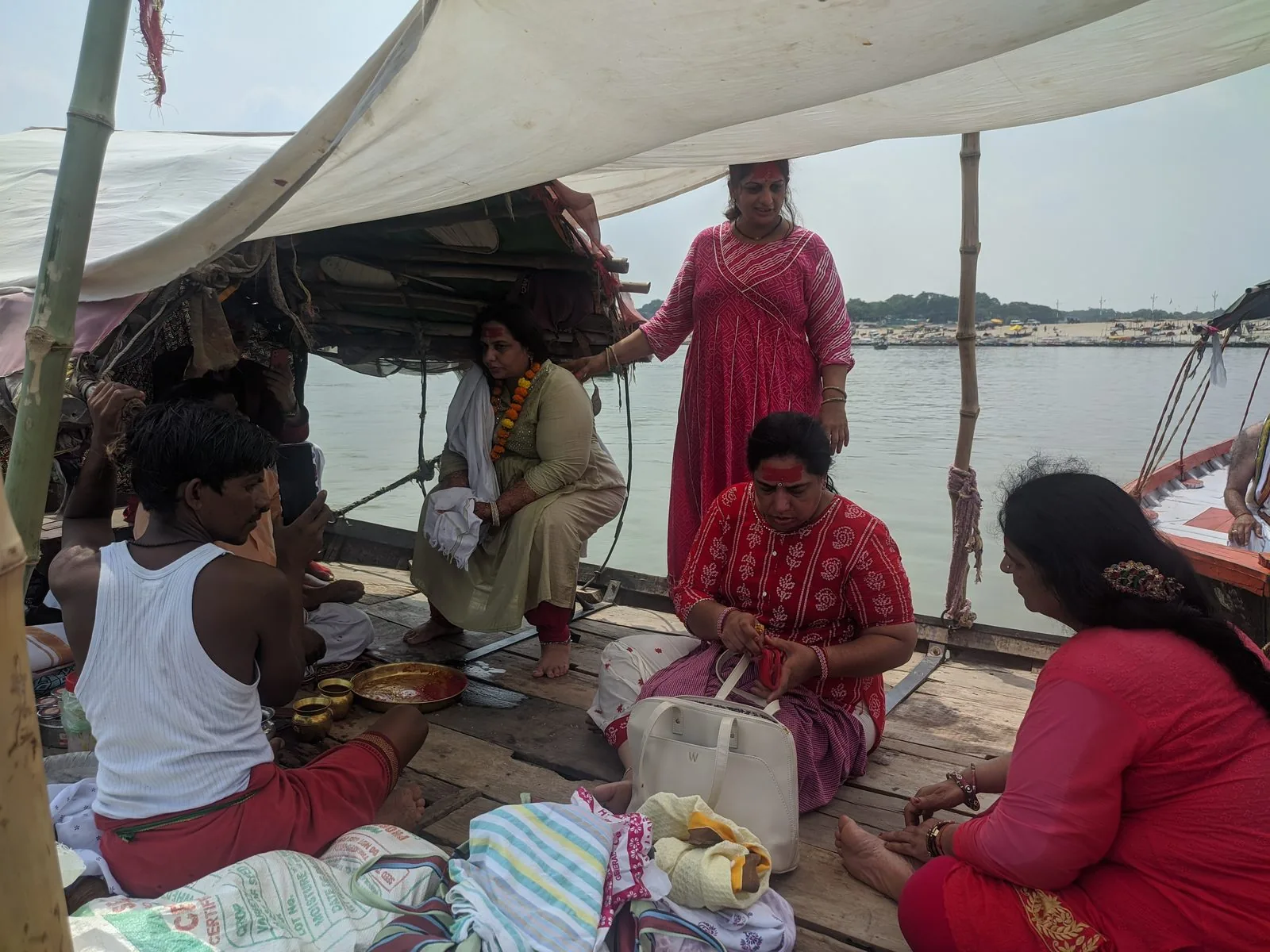
Three rivers, one offering.
The Ganga arrives from the north-west and the Yamuna from the south-west, and where they meet the difference is visible from a boat — two bodies of water running alongside one another before they mix. Tradition holds that a third river, the Saraswati, joins from below without appearing on the surface. Offerings at the Sangam are understood to be received by all three.
Ganga
The paler of the two waters at the meeting point, and the one most families recognise on sight.
Yamuna
Deeper in colour, so the line where the two run alongside one another is visible before they mix.
Saraswati
Held by tradition to join from below. Offerings at the Sangam are understood to reach all three.
Southern Uttar Pradesh, at the meeting of the two rivers. Kashi lies roughly 120 km downstream, which is why families often ask about both together.
The water decides more than the calendar.
At most sites the season affects comfort. At Prayagraj it affects the rite itself: whether the confluence can be reached by boat, how far out the meeting line sits, and where on the bank a family can gather. This is the single thing worth discussing before anything else.
A coordinator will describe current conditions rather than predict them. We would not promise boat access on a particular date.
- October to February
- Generally the most settled period, and the one families are most often advised to consider.
- Magh (mid-Jan to mid-Feb)
- The Magh Mela draws very large numbers to the same water. Considered highly auspicious, and extremely crowded.
- March to June
- Lower water. The confluence sits differently and the walk across the bank is longer.
- Monsoon (July to September)
- High water and strong current. Boats may not run, and rites are performed from the bank instead.
A confluence, and a very large gathering.
Prayagraj is known to most people through the Magh Mela and the Kumbh, which draw enormous numbers to the same water. Underneath that scale is a much quieter and older practice: families arriving at the Sangam to make offerings for their ancestors, often on an ordinary morning with very few people present.
For families watching from a distance it is the most legible of the sites. There is open water on every side, the confluence line is usually visible in frame, and nothing stands between the offering and the river.
Two rivers you can see. The third is taken on faith — which is much of what a rite asks of anyone.
What families arrange at the Sangam.
Whether a rite suits your family is not something this page can decide. What follows is what is customarily arranged here.
Preparing for a rite at the water.
The confluence is reached by boat when conditions allow, so there are a few human-scale things worth thinking about that do not arise at other sites.
Getting into the boat
A short passage out to the meeting line. Stepping in and out is the part families most often ask about, particularly with elders present.
How many can come
Boat capacity is limited and varies. If a larger group intends to be present, say so early so it can be planned rather than improvised.
Time of day
Rites are usually performed in the early morning, when the water is calmest and the light is best for anyone watching remotely.
If the river will not allow it
The rite is performed from the bank at Daraganj instead. A coordinator will tell you which is likely, and confirm on the day.
What helps to have ready.
Bring whatever your family knows. Missing details are common.
- Names of those being remembered, as your family says them.
- Gotra if it is known — many families do not know theirs, and that is provided for.
- Any date of passing you hold; the tithi can be worked out from a calendar date.
- Who intends to be present, and whether anyone needs to stay on the bank.
Getting to Prayagraj.
- By air
- Prayagraj (IXD), approx. 12 km
- By rail
- Prayagraj Junction, on the Delhi–Howrah line
- Nearby
- Kashi, approx. 120 km
- Local transfer
- Arranged locally; described before you travel
Reaching the confluence means stepping into and out of a boat, and the bank is sand and uneven ground. For elders or anyone with limited mobility, rites can be arranged from the bank instead — tell a coordinator and they will describe both. Neither is treated as lesser.
During the Mela months the whole area is far busier. Families wanting a quiet rite usually ask about dates outside them.
Ask about the confluence, and the season.
A coordinator will describe what is customary at the Sangam, what the river is doing, and what your family would need to decide. Nothing is booked or paid for on this website.
Continue to the enquiry form
Prayagraj is already selected. Add the details you know and we will reply by phone or WhatsApp.
We use these details to reply to this enquiry.
- The textual or lineage basis used to explain the confluence in the proposed rite
- Current ghat, pontoon and boat practice at the Sangam
Ask the pandit to explain the religious procedure.
Ask us to reconfirm ghat, boat and meeting details for your date.
Tell us about any mobility, language or participation needs.